
Adrenal Fatigue Diet: Does What You Eat Actually Matter?

Let’s start with the honest part: adrenal fatigue is not a recognized medical diagnosis. You will not find it in a diagnostic manual, and most endocrinologists will tell you plainly that it isn’t a real condition.
And yet — the exhaustion that brings women to that term is completely real.
If you are dragging yourself through the morning, hitting a wall at 3 p.m., then feeling strangely wired at 10 p.m. when you finally have a moment to yourself, something is happening in your body. If your provider ran a cortisol test, told you your adrenal function is normal, and sent you on your way, you may have walked out feeling dismissed rather than reassured. Normal labs don’t erase how you feel.
This post is an honest look at what’s actually going on when people use the phrase “adrenal fatigue,” why the more accurate term is HPA axis dysregulation, and — the part we care most about as dietitians — where food genuinely fits into the picture.
At Functional Nutrition Rx, the “burnout” feeling our clients experience is real. About 50% of new hormonal health clients arrive using the word adrenal fatigue or “burned out”. They have tried supplements and diets without much relief of symtpoms.
This article is educational and is not a substitute for evaluation by a physician. Persistent fatigue deserves a proper medical workup.
What Is Adrenal Fatigue, and Is It a Real Condition?
The term “adrenal fatigue” was popularized in the late 1990s with a specific theory attached: that chronic stress eventually “burns out” your adrenal glands until they can no longer produce enough cortisol.
The Endocrine Society and the broader endocrinology community do not recognize adrenal fatigue as a diagnosis, and systematic reviews of the research have not found consistent evidence that fatigue correlates with impaired adrenal output in otherwise healthy people. Your adrenal glands are remarkably resilient organs. They don’t run out of battery.
So what is real?
True adrenal insufficiency is real, and it’s a serious medical condition. Addison’s disease and secondary adrenal insufficiency involve genuine failure of cortisol production, diagnosed through specific testing (ACTH stimulation, morning cortisol) and treated with hormone replacement. This is not what most people mean when they say adrenal fatigue — but it’s exactly why a physician workup matters before anyone starts self-treating.
HPA axis dysregulation is also real. This describes a disruption in the communication and rhythm of the stress-response system rather than a failure of the glands themselves. It’s a subtler, more accurate framing, and it maps much better onto what women actually describe:
- Fatigue that sleep doesn’t seem to fix
- Brain fog and difficulty concentrating
- Waking exhausted, no matter the bedtime
- A hard afternoon crash, often around 2–4 p.m.
- Feeling “tired but wired” at night
- Intense salt or sugar cravings
- Poor recovery from stress — small things feel enormous
- Low tolerance for exercise that used to feel easy
Here’s how I think about it: the label may be wrong, but the pattern is right. Whether we call it “adrenal fatigue” or HPA axis dysregulation, it needs to be addressed with proper diet and lifestyle interventions.
How Does the HPA Axis Work — and What Throws It Off?
The hypothalamic-pituitary-adrenal (HPA) axis is a three-part communication loop:
- Your hypothalamus senses stress — physical, emotional, metabolic — and sends a signal.
- Your pituitary gland receives that signal and releases ACTH.
- Your adrenal glands respond by releasing cortisol.
Cortisol then circles back to tell the hypothalamus to stand down. It’s a thermostat, not a switch.
Cortisol itself has a bad reputation it doesn’t fully deserve. You need it. It mobilizes glucose for energy, regulates blood pressure, modulates immune function and inflammation, and helps you wake up in the morning. The problem is rarely “too much cortisol” or “too little cortisol” in isolation — it’s cortisol at the wrong time.
The cortisol rhythm
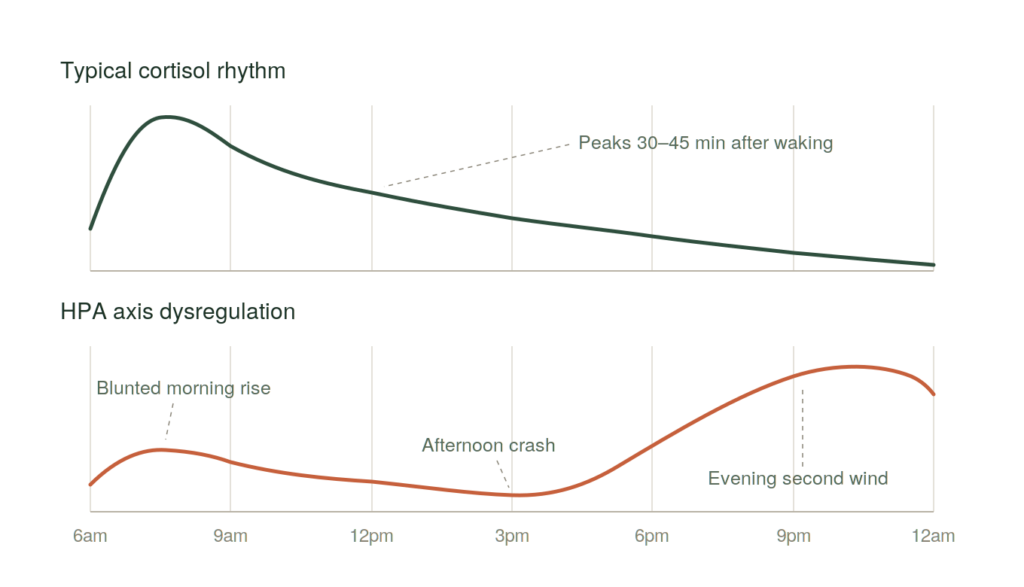
In a well-regulated system, cortisol surges within 30–45 minutes of waking (the cortisol awakening response), then tapers gradually across the day and bottoms out at night so melatonin can do its job.
When that rhythm flattens or inverts, the day-to-day experience is very specific: you wake up feeling like you’ve been hit by a truck, you drag through the morning on caffeine, you crash mid-afternoon, and then somewhere around 9 or 10 p.m. you get a second wind and can’t fall asleep. That’s a blunted cortisol awakening response with a delayed evening rise — and it’s one of the most common patterns women describe.
What disrupts the rhythm
- Chronic psychological stress — caregiving, financial strain, high-demand work, unprocessed grief
- Insufficient or fragmented sleep, including from young children, shift work, or perimenopausal night waking
- Undereating — either intentional restriction or the accidental kind that happens when you’re too busy to eat
- Blood sugar swings across the day
- Overtraining relative to recovery and fuel
- Untreated illness or inflammation, including thyroid dysfunction, anemia, sleep apnea, or long-COVID
Anything that causes stress on the body can disrupt cortisol rhythm. It is highly dependent on the individual, for example morning fasting may be negative for someone or not eating before you exercise. At Functional Nutrition Rx we help you determine what is optimal for your health.
Does Nutrition Actually Play a Role in HPA Axis Dysfunction?
Yes — and more directly than most people expect.
Cortisol is, among other things, a blood sugar hormone. One of its primary jobs is to raise blood glucose when it drops. That single fact explains most of the connection between how you eat and how your stress system behaves.
Underfueling is a physiological stressor. When intake is chronically below need — through skipped meals, long fasting windows layered onto an already-restrictive intake, or the caloric deficit of dieting — the body reads it as a threat and recruits cortisol to keep blood sugar available. Research in athletes with low energy availability shows meaningful disruption to HPA axis function and reproductive hormones. You don’t have to be an athlete for this to apply.
Blood sugar instability may be the single most underrecognized driver of “adrenal” symptoms. Consider the common sequence: coffee on an empty stomach, a rushed carb-heavy lunch around 1 p.m., a glucose spike, a reactive drop by 3 p.m., and then the shakiness, irritability, and desperate sugar craving that follow. That crash isn’t a willpower failure. It’s a counter-regulatory cortisol and adrenaline response doing exactly what it’s designed to do.
Do that five days a week for two years, and the “adrenal fatigue” symptom list starts to look inevitable.
Skipping breakfast deserves specific mention. Morning is when the HPA axis is most active. Going five or six hours after waking without food — while caffeinated — asks cortisol to carry the entire metabolic load.
Recently, one client I was working with came in feeling a lack of energy to play with her kids. She was trying intermittent fasting and not eating until lunch time. We adjusted her meal timing to include a protein rich breakfast within an hour of waking and waiting to drink coffee with breakfast. After a few weeks she started to see more energy throughout the day.
What Should You Actually Eat to Support Adrenal Health?
There is no magic adrenal food. What there is: a set of eating patterns that stop asking cortisol to work overtime.
Build a stable foundation
- Eat within 1–2 hours of waking. This is the highest-leverage change most women can make, and often the hardest to accept.
- Eat every 3–5 hours. Consistency beats perfection.
- Anchor every eating occasion with protein — roughly 25–35 g at meals for most adult women — alongside fat and fiber. This trio flattens the glucose curve more effectively than any single food swap.
- Don’t drink your caffeine before you eat anything. Food first, then coffee.
- Hydrate with electrolytes, especially if you sweat heavily, work outdoors, or feel lightheaded standing up.
Nutrients that support the stress-response system
These are supportive, not curative — and they work best from food:
- Vitamin C — concentrated in adrenal tissue and used during cortisol synthesis. Citrus, peppers, kiwi, strawberries, broccoli.
- B vitamins, especially B5 (pantothenic acid) and B6 — cofactors in steroid hormone production and neurotransmitter synthesis. Eggs, salmon, poultry, mushrooms, sunflower seeds, legumes, whole grains.
- Magnesium — involved in HPA axis regulation and sleep quality; commonly underconsumed. Pumpkin seeds, dark chocolate, leafy greens, black beans, almonds.
- Sodium — genuinely relevant for some people, particularly those with low blood pressure or orthostatic symptoms. This is individualized, and it is not license for a blanket salt recommendation.
The carbohydrate conversation
This is where I push back hardest on the internet version of adrenal healing.
If you are exhausted and have responded by cutting carbohydrates, you may be making the pattern worse. Carbohydrate restriction has been shown to raise cortisol in some contexts, and low-carb eating tends to suppress the thyroid conversion of T4 to T3 — the opposite of what a fatigued person needs. Carbohydrates also support serotonin availability and sleep quality.
Adequate carbohydrate — spread across the day, paired with protein, weighted toward whole-food sources — is usually part of the answer, not the problem.
A realistic day of eating
Not a protocol. Just a shape.
- 7:30 a.m. — Two eggs scrambled with spinach, a slice of sourdough with butter, half an orange. Coffee after.
- 10:30 a.m. — Greek yogurt with berries and pumpkin seeds.
- 1:00 p.m. — Grain bowl: quinoa, roasted chicken, chickpeas, cucumber, olive oil and lemon.
- 4:00 p.m. — Apple with almond butter, or hummus with peppers and crackers.
- 6:30 p.m. — Salmon, roasted potatoes, broccoli, plus something you enjoy.
Notice what this isn’t: it isn’t elimination, it isn’t fasting, and it isn’t 12 supplements. It’s food, on a schedule, with enough of it.
What Foods or Patterns Make HPA Axis Symptoms Worse?
Excess caffeine — especially on an empty stomach. Caffeine acutely raises cortisol, and the effect is amplified when you’re already stressed and unfed. If you’re relying on caffeine to function, it’s worth noticing that the tool masking the symptom may be reinforcing the cause. Most people do better keeping intake moderate and cutting it off by early afternoon, given caffeine’s roughly five-hour half-life.
Alcohol. Even one or two drinks fragment sleep architecture, suppressing REM and increasing overnight waking — and alcohol influences cortisol release directly. The “glass of wine to unwind” often costs more the next morning than it gave the night before.
Skipped meals and very low calorie diets. Covered above, and worth repeating: chronic underfueling is one of the most reliable ways to keep a stress-response system activated.
Very long fasting windows layered on top of high stress and poor sleep. Intermittent fasting isn’t harmful for everyone, but for an exhausted woman with disrupted sleep and irregular cycles, it frequently adds fuel to the fire.
What About Adaptogens and Supplements?
Clients almost always ask, so let’s be straightforward about the evidence.
- Ashwagandha — has the most human data of the group, with several small randomized trials showing modest reductions in perceived stress and serum cortisol. Studies are short and often industry-funded. It also is contraindicated if you have uncontrolled hyperthyroidism, are pregnant, and have certain cancers.
- Rhodiola — some evidence for perceived fatigue and mental performance under stress. Study quality is mixed.
- Holy basil (tulsi) — limited human data; preliminary findings on stress and glucose.
- Licorice root — meaningfully affects cortisol metabolism, which is exactly why it requires caution. It can raise blood pressure and lower potassium. This one should never be self-prescribed and warrants a discussion with your dietitian before starting.
Honest summary: these supplements can be beneficial to after lifestyle and diet changes are made. They are also not a substitute for sleep, adequate food, and addressing the stressor. A supplement layered on top of a 1,200-calorie day and five hours of sleep is a very expensive way to stay tired.
How a dietitian evaluates whether a supplement makes sense: we look at your intake first, identify genuine nutrient gaps, review your medications and conditions for interactions, consider your goals and timeline, and — if a supplement is warranted — recommend a specific third-party-tested product at a specific dose with a specific plan for reassessment.
That’s individualized care within a dietitian’s scope. Broad “everyone with fatigue should take X” advice is not.
How Can a Registered Dietitian Help with HPA Axis Symptoms?
Dietitian-led care for this pattern is less mysterious than it sounds:
- Meal pattern analysis — mapping what you actually eat and when, then finding where the gaps are creating cortisol demand
- Energy and nutrient adequacy assessment — often revealing an intake far below need
- Blood sugar strategy — building meals that hold, sometimes supported by continuous glucose monitoring data
- Targeted nutrient repletion — informed by labs and intake, not guesswork
- Behavior change that survives real life — a plan that works on a Tuesday with three kids and a commute
We work alongside your physician, not instead of them. Persistent fatigue warrants a medical workup: thyroid panel, CBC, ferritin and full iron studies, B12, vitamin D, A1c, and a morning cortisol where indicated. Sleep apnea, anemia, thyroid disease, and depression all present as “adrenal fatigue” and all have specific treatments.
On cortisol testing: morning serum cortisol is a validated tool for diagnosing adrenal insufficiency. Five-point salivary cortisol and the DUTCH test are widely used in functional medicine to map rhythm rather than diagnose. They can be useful is as one input among many, interpreted in the context of your symptoms, intake, and sleep. What we do with that information is nutritional and behavioral.
Frequently Asked Questions About Adrenal Fatigue and Diet
Is adrenal fatigue the same as Addison’s disease?
No. Addison’s disease is a diagnosed medical condition in which the adrenal glands genuinely fail to produce adequate cortisol and aldosterone, usually from autoimmune destruction. It’s identified with specific testing and treated with hormone replacement — it is not managed with diet. “Adrenal fatigue” describes a symptom cluster with normal adrenal function.
Can I fix adrenal fatigue just by changing my diet?
Diet is a powerful lever, and for some women, correcting underfueling and blood sugar swings resolves most of the symptoms. But if the underlying driver is five hours of sleep, an untreated thyroid condition, or a chronic stressor you haven’t been able to change, food alone won’t get you there. Nutrition works best as part of a fuller picture.
Should I be taking a cortisol test?
If there’s clinical suspicion of true adrenal insufficiency, a morning serum cortisol or salivary cortisol awakening response is an appropriate starting point.
Is low carb or keto a good idea when I am exhausted and stressed?
Usually not. Carbohydrate restriction can raise cortisol, impair T4-to-T3 thyroid conversion, and worsen sleep — a difficult combination for someone already depleted. If you’ve cut carbs and feel worse, that’s meaningful information, not a sign you need to cut harder.
How long does recovery from HPA dysregulation take?
Most women notice improvements in energy stability and afternoon crashes within 3–6 weeks of consistent changes to meal timing and adequacy. Deeper shifts in sleep quality, cycle regularity, and stress resilience typically take 3–6 months. Recovery follows the length and intensity of what depleted you — and it’s rarely linear.
Final Thoughts: Your Body Is Asking for Something Real
You are not imagining this.
The label may be scientifically imprecise, but the fatigue, the crashes, the wired-at-midnight exhaustion, the sense that your body stopped responding the way it used to — that’s real, it’s measurable in its effects on your life, and it deserves to be taken seriously.
What’s genuinely hopeful is that nutrition is one of the most accessible and evidence-informed levers you have. Not through a restrictive protocol or a cabinet full of adaptogens, but through the work of eating enough, eating regularly, stabilizing blood sugar, and building in real recovery.
That work goes better with someone who knows what to look for. Generic “adrenal reset” plans found online don’t know your labs, your cycle, your medications, your schedule, or how much you’re actually eating. A registered dietitian does.
If you’re tired of being told everything looks fine while you feel anything but — book a session with our team. We’ll look at the whole picture, together.
Also worth reading: Low Progesterone: Symptoms Women Are Often Told to Ignore
Written by the Functional Nutrition Rx team — registered dietitian nutritionists specializing in root-cause, functional nutrition counseling for women’s health, gut health, and hormonal balance. Located in Babylon, NY and available via telehealth throughout New York State. Most insurance accepted
Medically reviewed by Christina Lombardi, MS, RD
Why might you be feeling “off”? Find your root cause pattern with our free quiz.
You’re eating well. You’ve tried supplements. Maybe you’ve even done testing. But something still feels… off. If this sounds familiar, you’re not alone. You’re not doing anything wrong. You just haven’t been given the right answers yet. Take Functional Nutrition Rx’s free quiz, It takes 2 minutes—and could completely change how you approach your health.